💧 WHAT ACTUALLY HAPPENS IN A WATER SUPPLY PROJECT?
When we turn on a tap, we usually see only the final step.
But behind that one tap is an entire infrastructure network.
A typical water supply system can involve:
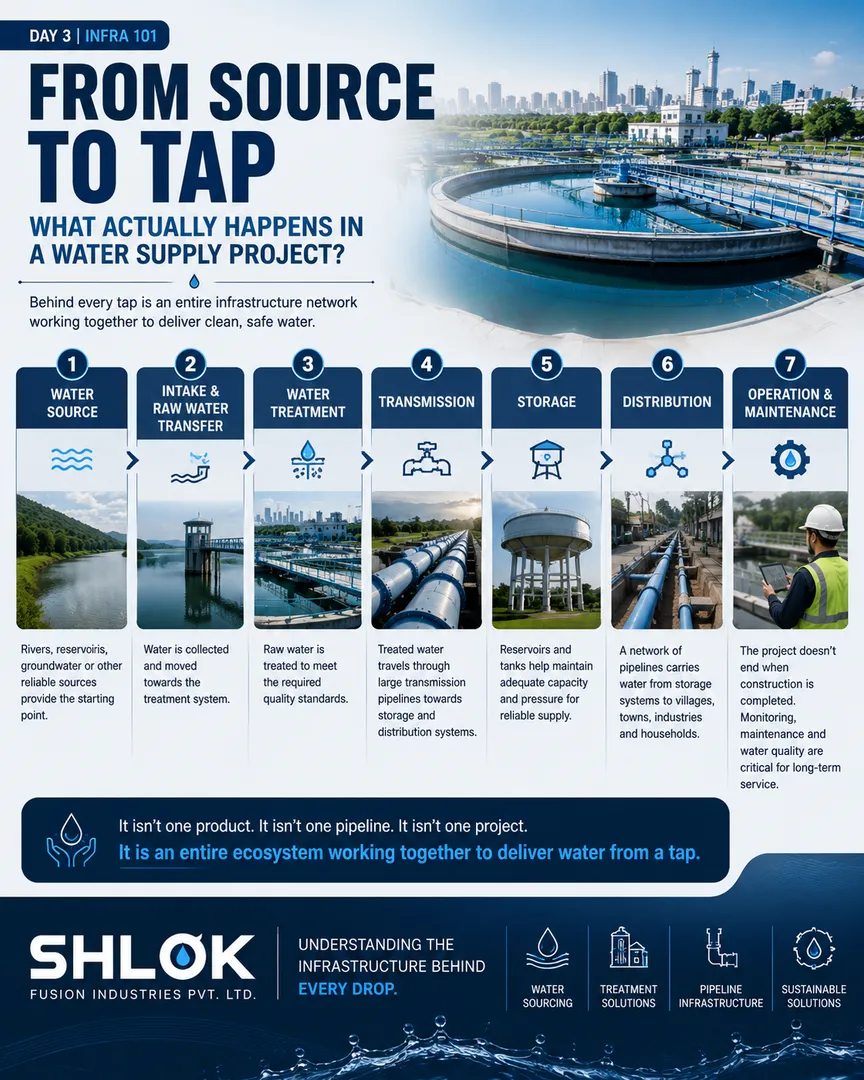
1️⃣ WATER SOURCE
Rivers, reservoirs, groundwater or other reliable sources provide the starting point.
2️⃣ INTAKE & RAW WATER TRANSFER
Water is collected and moved towards the treatment system.
3️⃣ WATER TREATMENT
Raw water is treated to meet the required quality standards before entering the supply network.
4️⃣ TRANSMISSION
Treated water travels through large transmission pipelines towards storage and distribution systems.
5️⃣ STORAGE
Reservoirs and tanks help maintain adequate capacity and pressure for reliable supply.
6️⃣ DISTRIBUTION
A network of pipelines carries water from storage systems to villages, towns, industries and households.
7️⃣ OPERATION & MAINTENANCE
The project doesn't end when construction is completed. Monitoring, maintenance, water quality and system performance are critical for long-term service.
The official Jal Jeevan Mission framework itself recognises components ranging from reliable water sources and treatment plants to bulk transfer, distribution networks and in-village infrastructure.
And this is what makes water infrastructure different:
It isn't one product.
It isn't one pipeline.
It isn't one project.
It is an entire ecosystem working together to deliver something as simple as water from a tap.
At Shlok, we're going deeper into this ecosystem — one project, one technology and one market insight at a time.
SHLOK
Understanding the infrastructure behind every drop.
#Shlok #WaterInfrastructure #WaterSupply #WaterProjects #InfrastructureIndia #WaterManagement #JalJeevanMission #WaterTreatment #PipelineInfrastructure #Engineering #IndiaInfrastructure
Keywords